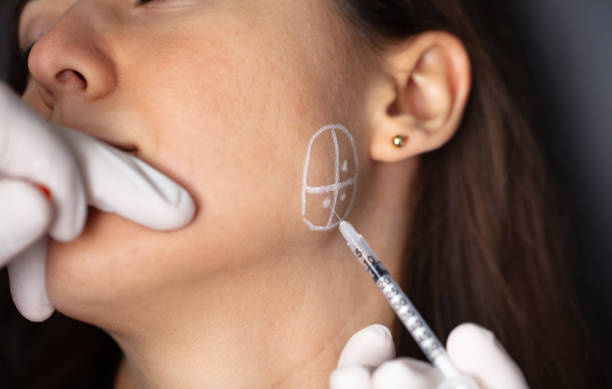
A slimmer jawline is possible only when muscle is the cause
At Dr. Orhan Demirer’s dermatology practice in Alsancak, masseter botulinum toxin treatment is planned after distinguishing muscle hypertrophy and clenching from mandibular bone width, local fat, chin support and skin laxity. The same injections may be considered for selected jaw-muscle symptoms, but they do not diagnose or cure every form of bruxism.
- Masseter strength, thickness and side-to-side symmetry assessed during clenching
- Aesthetic and functional goals discussed separately
- Individual dose and usually 3–5 planned injection points per masseter
- Chewing function, smile movement and lower-face proportions prioritised

What is Masseter Botox?
The masseter is a powerful chewing muscle at the angle of the jaw. Botulinum toxin temporarily reduces selected nerve-to-muscle signalling. When injected into an appropriately identified portion of the masseter, it can reduce excessive contraction and, over time, decrease muscle volume.
Patients commonly search for “Masseter Botox,” “Jawline Botox,” “teeth-grinding Botox” or “facial slimming.” These phrases can describe two different objectives: reducing muscle-related jaw tension and reducing lower-face width caused by a bulky masseter. Improvement in one objective does not guarantee the other.
“Botox” is a familiar brand-derived term. Different botulinum toxin products have product-specific potency units, instructions and approved uses; units cannot be directly compared or converted. Masseter contouring and bruxism uses may be off-label depending on the product and jurisdiction.
A wide lower face is not always caused by the masseter
The treatment can reduce muscle-related width. It cannot narrow bone, remove a fat compartment or tighten loose skin.
Masseter hypertrophy
A prominent muscle that becomes firmer and more visible during clenching is the main anatomical target for masseter botulinum toxin.
Mandibular width
A broad mandibular angle is structural. Reducing muscle activity may soften the outline, but it cannot change the underlying bone.
Jowls or chin retrusion
Local fat, early jowling or limited chin projection may blur the jawline. Muscle reduction alone can leave the real cause unchanged.
Lower-face laxity
Reducing a large masseter can reveal or worsen a pre-existing jowl in susceptible anatomy because the muscle was contributing volume support.
Facial contour and jaw-muscle symptoms must be discussed separately
Aesthetic objective
Selected patients with true masseter hypertrophy may notice a softer mandibular angle and a narrower lower-face contour as muscle volume decreases over 4–8 weeks and sometimes continues to change over 2–3 months.
- Muscle-related square or bulky lower face
- Side-to-side muscle asymmetry
- Preference for gradual rather than immediate contour change
- Understanding that bone and fat are not removed
Functional objective
Reducing masseter force may help selected clenching-related muscle pain, jaw fatigue or perceived grinding. It does not correct dental wear, malocclusion, sleep disorders, temporomandibular joint disease or behavioural drivers.
- Clenching-related masseter tenderness
- Morning jaw fatigue
- Selected bruxism-related symptoms
- Need for dental or sleep assessment when indicated
Masseter Botox can reduce force; it may not remove the cause of grinding
Sleep bruxism, awake clenching and temporomandibular pain are not the same diagnosis. Stress, sleep quality, medication, stimulant use, dental contact, joint pathology and behavioural habits may contribute. Some trials suggest botulinum toxin can reduce contraction intensity, pain or maximum bite force, while evidence for eliminating bruxism episodes remains inconsistent.
For that reason, treatment is framed as symptom and muscle-force management in selected adults—not a guaranteed cure or a replacement for dental protection, sleep assessment, physiotherapy or behavioural management when these are indicated.
Who may be suitable—and when another plan may be better
Assessment may be relevant for
- Palpable, bulky or asymmetric masseter hypertrophy
- Muscle-related square lower-face width
- Selected clenching, jaw tension or morning muscle fatigue
- Adults seeking a temporary, non-surgical approach
- Patients who understand that slimming is gradual
- People willing to continue dental or sleep management when needed
Treatment may be postponed or insufficient
- Lower-face width mainly caused by bone, fat, gland or skin laxity
- Marked pre-existing jowls or a very thin lower face
- Active infection at an injection site
- Known hypersensitivity to the selected product
- Neuromuscular junction disorder or clinically significant swallowing/respiratory difficulty
- Pregnancy or breastfeeding for an elective procedure
Tell the physician about all medicines, supplements, recent botulinum toxin treatments, aminoglycoside antibiotics, muscle relaxants, dental procedures, facial surgery, fillers and existing weakness. Do not stop prescribed medication on your own.
What is assessed during consultation?
Rest and clench
The lower face is examined at rest and with strong clenching to identify the active muscle border and true hypertrophy.
Symmetry
Right and left muscle volume, strength, jaw deviation and natural facial asymmetry are recorded.
Smile and nearby muscles
Risorius and other smile-related movement is assessed because unwanted diffusion can affect the smile.
Jaw and teeth symptoms
Pain location, morning fatigue, wear, clicking, locking, headaches and previous splint or dental treatment are discussed.
Lower-face support
Chin position, mandibular bone, jowls, skin laxity and fat distribution help predict whether slimming will be harmonious.
Previous toxin response
Product, date, dose if known, duration, chewing changes, asymmetry and prior adverse effects influence the next plan.
How is Masseter Botox performed?
The injections are brief, but safe planning depends on locating the functional muscle and respecting adjacent smile muscles, the parotid region and variable anatomy.
History and goal
The primary objective—muscle symptoms, facial contour or both—is documented before treatment.
Dynamic examination
The patient clenches while the masseter’s anterior, posterior, superior and inferior boundaries are palpated.
Point and dose plan
Product-specific dose is divided across usually 3–5 points in each masseter; the exact number is not fixed.
Cleansing and injection
Fine needles place small amounts into the selected muscle zones. Discomfort is commonly brief but varies.
Immediate instructions
Small marks, tenderness or bruising are discussed together with eating, exercise and contact guidance.
Review timing
Function is assessed after the effect develops; contour needs longer because muscle volume changes gradually.
There is no universal unit dose, and units from different botulinum toxin products are not interchangeable. Publishing a single internet dose without naming the product, anatomy and treatment objective would be misleading.
When does Masseter Botox start working?
The injections may be tender. A final judgement should not be made immediately.
Reduced clenching strength or muscle tension may become noticeable. The muscle-relaxing effect is commonly assessed around week 3.
Facial slimming may become visible as the masseter gradually loses volume.
Contour change may continue to become clearer, especially in a previously bulky muscle.
Effect gradually wears off. Duration varies and repeat treatment should follow reassessment rather than a fixed calendar.
Muscle-related lower-face width, selected clenching force, masseter tenderness and side-to-side muscle imbalance.
Mandibular bone width, tooth wear already present, a retruded chin, a large fat compartment or advanced skin laxity.
A perfectly V-shaped face, complete cessation of grinding, headache resolution, identical symmetry or exactly 4–6 months of benefit.
Can I eat after Masseter Botox?
Yes. Most patients can eat immediately after treatment. Normal chewing does not need to be avoided completely, but very hard foods and prolonged gum chewing are best avoided for the first few hours unless the treating physician gives different instructions.
The practice’s individual advice takes priority over generic online rules. Do not repeatedly press, massage or test the treated muscle.
A temporary sense of chewing fatigue or reduced bite strength can occur. Noticeable difficulty should be reported rather than “trained through” with hard foods.
- Do not rub or apply sustained pressure to the injection sites.
- Avoid gum and very hard foods for the first few hours.
- Follow the advised interval before strenuous exercise.
- Expect possible pinpoint redness, tenderness or bruising.
- Do not add another toxin product without reporting the date and product used.
- Contact the practice if chewing, smile or swallowing changes develop.
Possible side effects and complications
Masseter botulinum toxin is usually well tolerated in appropriately selected patients, but it is not risk-free. Effects may appear over days to weeks and last until muscle function recovers.
Injection-related effects
Brief pain, redness, swelling, tenderness, bruising, headache or infection can occur. A small lump immediately after injection is not the same as the later “paradoxical bulging” phenomenon.
Chewing and bite changes
Reduced bite force, chewing fatigue or temporary difficulty with hard foods may occur. Symptoms are more relevant when dose, baseline muscle reserve or bilateral balance is unsuitable.
Smile and contour changes
Smile asymmetry, lower-lip or cheek movement change, excessive facial slimming, jowl accentuation, hollowing or other contour asymmetry may occur if toxin spreads or volume support is reduced.
Masseter-specific effects
Paradoxical bulging of an untreated muscle segment, under-correction, over-correction, asymmetry or compensatory use of other chewing muscles can require observation or adjustment.
Seek urgent medical assessment for difficulty swallowing, speaking or breathing; generalised weakness; double vision; widespread allergic swelling; or rapidly worsening symptoms. These can occur hours to weeks after botulinum toxin exposure and should not wait for a routine review.
Safety information was cross-checked against the current BOTOX Cosmetic prescribing information, a large published series on masseter injection complications, and a recent cohort evaluating functional and aesthetic outcomes. Exact risk depends on the selected product, dose, anatomy and treatment objective.
Bruxism improvement should not be described as a guaranteed cure
Research suggests botulinum toxin may reduce the intensity of jaw-muscle contractions, bite force and pain in selected patients. However, studies use different diagnoses, products, doses and outcome measures, and some evidence remains inconclusive about eliminating bruxism itself.
What treatment may do
Reduce masseter activity and selected muscle symptoms while dental, sleep and behavioural contributors are managed separately.
What treatment does not prove
That grinding episodes have stopped, teeth are protected permanently, joint disease is treated or every headache is masseter-related.
See the published review of randomised bruxism trials and a separate systematic review describing evidence limitations.
Masseter Botox, jawline filler, Endolift or a dental approach?
| Method | Main target | May be more relevant when | Important limitation |
|---|---|---|---|
| Masseter botulinum toxin | Excess masseter activity and muscle volume | Clenching-related muscle symptoms or muscle-driven lower-face width | Does not change bone, remove fat or correct advanced laxity; may weaken chewing temporarily |
| Dental splint / dental care | Tooth protection, occlusal or dental assessment | Grinding has caused wear, fracture risk or dental symptoms | Does not automatically reduce a bulky muscle or every source of pain |
| Physiotherapy / behavioural care | Habit, muscle use, posture and pain management | Awake clenching, myofascial pain or functional triggers are important | Requires participation and may not create aesthetic narrowing |
| Jawline or chin filler | Projection and structural support | Chin retrusion or an under-supported mandibular contour dominates | Adds volume; it does not reduce masseter activity |
| Endolift-style laser | Selected local fat and lower-face laxity | Jawline blurring is caused by fat or soft-tissue laxity rather than muscle | Minimally invasive and does not treat clenching |
| Nefertiti / platysma Botox | Selected downward platysma activity | Neck bands or platysma pull affects the jawline | A different muscle target; does not reduce masseter size |
Masseter Botox prices in Izmir
Pricing depends on the selected product, masseter strength and volume, asymmetry, treatment objective, product-specific dose, whether both sides require the same plan and the review arrangement. A very strong bilateral masseter plan is not equivalent to a small upper-face injection area.
Because botulinum toxin units are product-specific and not interchangeable, price should not be compared by “unit” without naming the product and treatment plan.
Tell the practice whether your main concern is clenching, pain, muscle bulk, facial asymmetry or lower-face width.

Masseter Botox planning with Dr. Orhan Demirer
Dr. Orhan Demirer is a specialist dermatologist practising in Alsancak, Izmir. He assesses lower-face proportions, masseter activity, smile movement, asymmetry, skin laxity and treatment history before deciding whether botulinum toxin is proportionate.
If the dominant concern is dental damage, joint dysfunction, sleep-related grinding, chin retrusion, local fat or advanced jowling, dental, sleep, physiotherapy, filler, energy-based or surgical assessment may be more appropriate than increasing the toxin dose.
- Specialist in dermatology
- Dynamic facial and muscle assessment
- Natural lower-face proportion prioritised
- English communication available
Masseter Botox in Izmir for international patients
Visitors can share their main concern and previous toxin date before travelling, but photographs cannot measure muscle strength, locate pain or establish a final product and dose plan.
Share preferred dates, clenching symptoms, dental history and the date/product of previous botulinum toxin.
Rest, clench, smile, asymmetry, jaw support and treatment objectives are assessed in person.
The effect develops after departure; plan how to report chewing, smile or asymmetry concerns and when contour will be reviewed.
Frequently asked questions about Masseter Botox in Izmir
What is Masseter Botox?
It is botulinum toxin injection into selected portions of the masseter chewing muscle to temporarily reduce excessive activity and, over time, muscle volume.
Is Jawline Botox the same as Masseter Botox?
The phrases are often used interchangeably online, but “jawline Botox” may also refer to platysma or Nefertiti treatment. The injected muscle and goal should be named clearly.
Can Masseter Botox make my face slimmer?
It may slim a lower face that is wide because of true masseter hypertrophy. It cannot narrow mandibular bone, remove jowl fat or correct a retruded chin.
How many injection points are used?
The practice commonly plans approximately 3–5 points in each masseter, but the exact number and location depend on the palpable muscle, anatomy, asymmetry and selected product.
When is the maximum effect seen?
Muscle relaxation is commonly assessed around week 3. Visible facial slimming is slower and may become clearer over 4–8 weeks, sometimes continuing through 2–3 months.
How long does Masseter Botox last?
It commonly lasts around 4–6 months, but product, dose, muscle strength, clenching, metabolism and previous treatment influence duration.
Can I eat immediately after treatment?
Yes, normal eating is generally possible immediately. Avoid prolonged gum chewing and very hard foods for the first few hours unless your physician advises otherwise.
Will it affect chewing?
Normal eating is usually maintained. Temporary reduction in bite force, chewing fatigue or difficulty with very hard foods can occur; noticeable or persistent difficulty should be reported.
Does Masseter Botox cure bruxism?
No cure can be guaranteed. It may reduce muscle-force intensity and selected symptoms, but sleep, dental, joint, medication, stress and behavioural contributors can continue.
Can it help jaw pain or headaches?
It may help selected masseter-related pain or tension. Jaw-joint pain and headaches have many causes, so improvement cannot be assumed without diagnosis.
Can Masseter Botox make jowls worse?
Reducing a bulky masseter may reveal pre-existing laxity or reduce lower-face support in susceptible patients. Skin, fat and baseline jowls are therefore assessed before treatment.
What is paradoxical masseter bulging?
It is a temporary focal bulge that can appear when an untreated portion of the masseter contracts more visibly after other fibres weaken. It requires clinical assessment rather than massage.
Can it make my smile asymmetric?
Yes, unintended diffusion into nearby smile muscles can alter movement. Safe-zone planning reduces but does not eliminate this risk.
Is the treatment painful?
Fine needles are used and discomfort is usually brief, but sensitivity varies. Small injection marks, tenderness or bruising can occur.
Can Masseter Botox be combined with jawline filler?
Sometimes. Botox reduces muscle activity while filler adds structural support. The sequence depends on whether muscle bulk, chin projection or jawline support is the dominant concern.
Is Masseter Botox suitable for men?
Yes, when there is a relevant functional or muscle-hypertrophy indication. The plan should respect the individual’s preferred facial proportions rather than apply a feminising template automatically.
Can treatment be performed during pregnancy?
Dr. Orhan Demirer generally postpones elective botulinum toxin treatment during pregnancy and breastfeeding because safety information is limited.
How much does Masseter Botox cost in Izmir?
The fee depends on product, muscle strength, asymmetry, objective, product-specific dose and follow-up. A personal scope and fee are discussed after assessment.
First decide whether the concern comes from muscle, bone, fat, support or skin
A personal masseter plan begins with clenching examination and lower-face anatomy—not a fixed bilateral dose.