

A sharper jawline is not always a filler problem

At Dr. Orhan Demirer’s dermatology practice in Alsancak, jawline filler is considered only after separating mandibular bone contour from chin position, masseter bulk, submental fat, jowls and skin laxity. Filler adds material; it does not biologically slim the face, dissolve a double chin or reproduce a surgical lift.
- Bone, muscle, fat and skin causes assessed separately
- Jawline border distinguished from chin-tip projection
- Front-view width checked—not only the perfect side profile
- Measured volume, alternatives and vascular risk discussed clearly
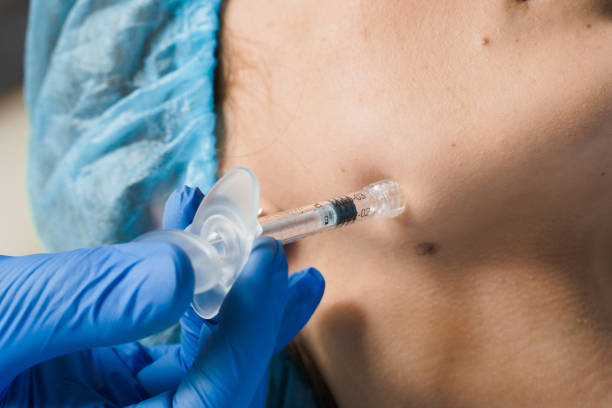
Four structures can blur, widen or interrupt the jawline
A photograph labelled “weak jawline” does not identify which tissue should be treated. Several causes may coexist, and adding filler to the wrong one may increase heaviness.
Mandibular framework
The angle, body and chin create the underlying line. Filler may temporarily camouflage selected contour deficiency but cannot rebuild a major skeletal discrepancy.
Masseter size and activity
Muscle bulk, clenching and lower-face width require a different assessment. Filler does not reduce muscle and can add further width.
Submental and lower-face tissue
Fat under the chin or over the border can obscure a bony line. Filler does not dissolve fat; contour camouflage has a clear limit.
Laxity and jowls
Skin elasticity, descended tissue and the neck transition affect definition. Filling around significant laxity can make the lower face look heavier.
Dental occlusion, chin position, neck anatomy, previous filler and facial movement also influence the visible border. A new one-sided lump, pain, weakness or rapidly changing asymmetry needs medical assessment rather than cosmetic camouflage.
“Jawline filler” can describe several different injection intentions
Posterior definition
Selected support near the angle can affect the oblique and side view. Too much lateral volume may broaden the front view.
Border continuity
A local structural interruption may be softened. Filling the entire line automatically is not necessary and may create an artificial ridge.
Small contour gap
A limited depression in front of a jowl may be assessed, but filler does not remove descended tissue or truly lift the lower face.
Anterior anchor
A retruded or short chin can make the jawline look weak. Sometimes chin support matters more than adding along the full border.
Selected difference
A small volume-related difference may be softened. Bone, dental, muscle or movement-related asymmetry may remain.
Submental boundary
Filler may alter a shadow in selected anatomy but cannot remove fat, tighten major laxity or change the hyoid and neck framework.
Jawline filler and chin filler are not the same treatment
| Approach | Primary target | Possible contribution | Important limitation |
|---|---|---|---|
| Jawline filler | Mandibular angle, border and selected pre-jowl transition | Temporary contour support along chosen parts of the lower-face frame | Does not reduce masseter, fat or laxity; excess volume can widen the face |
| Chin filler | Anterior or downward chin projection and chin shape | Influence profile balance, lower-face length and lip–chin relationship | Does not automatically define the whole mandibular border or correct skeletal malocclusion |
| Combined plan | Chin anchor plus selected border support | Address two confirmed structural targets when each adds value | Should not be automatic; combined volume can over-project or enlarge the lower face |
| Orthodontic or surgical assessment | Dental–skeletal relationship, major retrusion or structural asymmetry | Assess a cause filler cannot treat | Different risk, recovery and treatment scope; filler is not an equivalent substitute |
What jawline filler may improve and what it cannot do
Selected goals that may be assessed
- Support a defined mandibular-angle or border deficiency
- Soften a small structural interruption or pre-jowl depression
- Improve lower-face contour from selected viewing angles
- Balance a limited volume asymmetry after diagnosis
- Coordinate with chin position without filling every point
What filler does not achieve
- Reduce fat, muscle, bone width or total facial mass
- Remove a double chin or significant jowls
- Reproduce skin tightening, liposuction or surgical lifting
- Correct a major skeletal or dental–jaw discrepancy
- Guarantee an identical, perfectly sharp line on both sides
A stronger outline in one side-profile photograph can coexist with an overly wide or heavy front view. A defensible result must remain proportionate from the front, both profiles, oblique views and during speaking and smiling.
Who may be considered—and when another pathway may be safer
Assessment may be relevant for
- A selected mandibular border or angle contour deficit
- A small pre-jowl transition rather than major tissue descent
- A realistic expectation of temporary added support
- A plan compatible with front-view facial width
- An adult able to maintain urgent contact and follow-up
- Complete disclosure of previous filler and facial procedures
Delay or another assessment may be needed
- Double chin where submental fat is the principal concern
- Marked skin laxity, prominent jowls or desire for surgical-level lifting
- Masseter-driven width, major skeletal retrusion or dental malocclusion
- Unknown old filler, new lump, active infection or recent dental procedure
- Pregnancy or breastfeeding for an elective procedure
- A requested volume likely to broaden or weigh down the face
Share medicines, supplements, allergies, bleeding history, inflammatory conditions, dental plans, clenching symptoms, previous botulinum toxin, filler, dissolving, threads, surgery and energy procedures. Do not stop prescribed medicines independently.
How is a jawline-filler plan personalised?
Define the requested change
“Sharper,” “slimmer,” “more masculine” or “more feminine” is translated into an exact anatomical target.
Standardised views
Front, both profiles, oblique and dynamic views are documented in consistent lighting and head position.
Separate the tissues
Bone, chin, masseter, fat, skin, jowls, neck transition and previous product are assessed.
Compare options
Chin support, masseter treatment, tightening, fat-focused or surgical assessment and no treatment are considered.
Choose product and layer
Traceability, tissue behaviour, planned plane and country-specific product information are reviewed.
Set the stop point
The lowest reasonable volume and the front-view width that must be preserved are agreed before treatment.
Inject and observe
Needle and/or cannula placement follows the plan while circulation, tissue response and contour are monitored.
Review after settling
Early swelling is allowed to settle before deciding whether any additional treatment is proportionate.
Hyaluronic acid, biostimulation and hybrid injectables serve different plans
Regulatory indications and approved anatomical sites are product- and country-specific. A general “jawline filler” label does not establish that a particular product is suitable for the intended target or layer.
May be considered for measured structural support when the selected product’s properties and current instructions fit the target.
Aims primarily for a gradual tissue response and is not a like-for-like substitute for a precisely reversible HA contour plan.
Combines carrier and stimulatory components. Timing, placement, indications and reversibility differ from HA alone.
These are different tools; neither eliminates vascular risk. Anatomy, target, layer, product and technique determine selection.
The sealed product, name, lot, amount and target should be recorded. Brand familiarity does not replace suitability.
Adding into an unidentified product, unexplained lump or irregular contour can compound the problem and may require further assessment first.
The current FDA dermal-filler guidance describes product- and site-specific approval and the possibility of serious vascular complications. Product information and regulation applicable in Türkiye take priority.
Old filler, masseter treatment and facial surgery must be reviewed first
If previous filler is present
The product, date, amount, distribution, migration, swelling and current front-view width are reviewed. Filler can persist longer than an expected marketing interval.
Repeated calendar-based top-ups along a long mandibular border can gradually increase facial width or create a visible ridge. No additional product may be the correct decision.
If other lower-face procedures were performed
Masseter toxin can change muscle activity and volume over time. Threads, surgery, lipolysis or energy procedures may change tissue planes, oedema and contour.
Records, observation, targeted examination or imaging where clinically relevant may be preferable before adding or dissolving product.
What happens during a jawline-filler appointment?
Medical review
Health history, medicines, allergies, dental plans, clenching and previous procedures are checked.
Facial examination
The lower face is viewed and palpated at rest, during clenching, speaking and smiling.
Target selection
Angle, border, pre-jowl, chin or no filler is selected according to the confirmed cause.
Informed plan
Product, amount, layer, alternatives, likely effects, limitations and urgent risks are discussed.
Cleansing and comfort
The skin is prepared; topical or local anaesthesia, cooling or lidocaine-containing product may be considered.
Measured injection
Needle and/or cannula placement follows the agreed target while circulation and tissue response are observed.
Immediate check
Contour, circulation and early symmetry are assessed; product name, lot and amount are recorded.
Aftercare and review
Written warning signs and contact instructions are provided; settled anatomy guides later decisions.
Recovery, settling and duration after jawline filler
This timeline is illustrative. Product, amount, number of points, previous filler and individual healing can change it.
Added contour is visible together with injection swelling. Tenderness, redness, small marks and temporary unevenness may occur.
Swelling and bruising may fluctuate and settle differently on each side. Early sharpness or asymmetry is not the final result.
Many routine effects have improved and front, side, oblique and dynamic balance is easier to reassess.
The effect gradually changes. Many HA fillers persist for months and sometimes beyond a year, but duration is variable.
Any gain in side-profile definition must be weighed against lower-face width and heaviness from the front.
Speaking, smiling and clenching should remain compatible with a natural lower-face contour.
Remaining product, chin balance and facial width are reassessed before maintenance.
Protect the area without trying to sculpt it at home
The treating physician’s individual instructions take priority over generic online advice. Do not press, massage or repeatedly “test” the jawline unless specifically advised for a defined finding.
A clean cool compress may be suggested for comfort. Follow personal instructions for makeup, exercise, heat, alcohol, shaving, dental care and other facial treatments.
- Do not judge symmetry from treatment-day swelling.
- Do not massage or push down firmness without assessment.
- Keep hands and unclean objects away from entry points.
- Do not stop prescribed medicines independently.
- Report increasing redness, warmth, discharge, fever or persistent swelling.
- Keep the practice’s urgent contact instructions available.
Common reactions, delayed problems and vascular emergencies
Jawline filler is a medical injection. Appropriate assessment, anatomy, product selection and technique reduce risk but cannot make it risk-free.
Common and usually temporary
Swelling, bruising, redness, tenderness, pain, itching, firmness, palpable product, entry marks and early asymmetry may occur and often improve over days to a few weeks.
Less common or delayed
Infection, persistent swelling, lumps, nodules, granuloma, delayed inflammation, migration, sensory symptoms, salivary or nerve-area injury, scarring and unwanted contour require assessment.
Possible blood-flow problem
Unusual or increasing pain, blanching, white-grey-blue or mottled skin, coolness, slow capillary refill, blisters or a worsening dusky area requires immediate contact and urgent assessment.
Vision or neurological symptoms
Any visual change, eye pain, drooping eyelid, severe headache, weakness, confusion, speech difficulty or another stroke-like symptom is an emergency requiring immediate medical care.
Safety language was cross-checked against current FDA guidance, a recent anatomy-based lower-face filler review and published guidance on recognising and managing HA filler vascular occlusion. Current Türkiye product information and local clinical pathways take priority.
Jawline filler, chin support, masseter treatment or tightening?
| Approach | Main target | May be relevant when | Important limitation |
|---|---|---|---|
| Jawline HA filler | Selected mandibular contour support | A true border or angle deficiency is confirmed | Adds volume; does not reduce fat, muscle or laxity |
| Chin filler | Anterior or downward chin projection | Chin position is weakening the profile and jawline anchor | Does not correct major skeletal or dental discrepancy |
| Masseter Botox | Selected masseter activity and bulk | Clenching or muscle-driven width is demonstrated | Does not add bony contour and may be unsuitable with existing laxity |
| Fat-focused assessment | Submental or lower-face adipose tissue | Fat—not weak bone contour—is obscuring the line | Filler does not dissolve fat; treatment choice and suitability vary |
| HIFU or Endolift | Selected laxity or tissue-remodelling concern | The problem is not primarily a contour-volume deficit | Neither substitutes for missing structural support or surgical lifting |
| Surgical review or no treatment | Major structural change or unfavourable risk–benefit | Filler would require excess volume or cannot meet the goal | Different recovery and risk profile; no procedure remains valid |
Jawline planning should preserve the individual face—not manufacture one universal shape
Terms such as “masculine jawline” or “V-line” may describe a preference, but they are not complete treatment plans. Bone shape, facial width, chin position, soft tissue, ethnicity, age, movement and the patient’s own identity matter more than a preset injection map.
A square contour is not mandatory
Increasing the mandibular angle may suit some faces and preferences but can make another lower face excessively wide or heavy.
A narrow contour is not mandatory
Reducing every lower face to a tapered shape can ignore natural bone structure, strength of features and the patient’s desired expression.
Jawline filler prices in Izmir
Pricing depends on whether the target is the mandibular angle, selected border points, pre-jowl transition or a coordinated chin plan; it also depends on the traceable product, required amount, previous treatment, staged planning and follow-up.
A millilitre price alone does not show product suitability, anatomical planning, asepsis, documentation, vascular-emergency readiness or follow-up access. High-volume packages can create pressure to use product beyond the actual need.
Describe the views that concern you and whether you also have clenching, a double chin, laxity, previous filler or lower-face procedures.

Jawline filler planning with Dr. Orhan Demirer
Dr. Orhan Demirer is a specialist dermatologist practising in Alsancak, Izmir. He evaluates mandibular anatomy, chin position, masseter activity, fat, skin laxity, facial movement, previous filler and the patient’s preferred degree of change before recommending treatment.
A consultation may appropriately conclude with a smaller or staged filler plan, chin-first planning, masseter treatment, another tissue-focused option, further assessment or no injection. The objective is not maximum sharpness; it is a proportionate lower-face contour.
- Specialist dermatology assessment
- Bone–muscle–fat–skin distinction
- Traceable product and individual amount
- English communication and follow-up
Planning jawline filler in Izmir from abroad
Photographs can show preferred angles but cannot palpate masseter, distinguish fat from laxity or identify old product. The final indication, product, amount and target are decided in person.
Share preferred dates, medicines, dental plans, clenching symptoms, previous filler/dissolving records and recent lower-face procedures.
The lower face is assessed from several angles and in motion; alternatives, recovery and urgent warning signs are discussed in English.
Allow for visible swelling and bruising. Keep urgent contact information and agree how the settled result will be reviewed after departure.
Do not schedule treatment immediately before a flight or onward travel that would prevent observation or urgent reassessment if an unusual symptom develops.
Jawline fillers in Izmir: patient questions
Are jawline filler and chin filler the same?
No. Jawline filler focuses on selected mandibular border or angle contour, while chin filler usually changes anterior or downward chin projection. They influence each other, but the targets, placement and effect on facial proportions are different.
Does jawline filler make the face slimmer?
It does not reduce fat, muscle or bone. Selected structural support may create a more defined border from some angles, but excessive or poorly placed volume can make the lower face wider and heavier.
Can jawline filler remove a double chin?
No. Filler does not dissolve submental fat. A retruded chin or weak mandibular contour may affect the shadow, but true fat, skin laxity and neck anatomy require separate assessment.
Jawline filler or masseter Botox: which is better?
They treat different structures. Filler adds temporary contour support; masseter botulinum toxin reduces selected muscle activity and may alter muscle bulk over time. Bone, muscle, fat and skin must be distinguished before choosing.
Jawline filler or HIFU: which should I choose?
Filler addresses selected structural contour or volume, whereas HIFU targets selected tissue-remodelling or laxity concerns. Neither is automatically better, and neither removes every cause of a blurred jawline.
Can jawline filler correct jowls?
It may soften a small pre-jowl transition in selected anatomy, but it does not remove descended tissue or reproduce a surgical lift. Adding volume along significant jowls can increase lower-face heaviness.
How many millilitres of jawline filler are needed?
There is no standard amount. The mandibular angle, border length, chin relationship, facial width, soft-tissue thickness, previous filler and product properties all affect the plan. Volume is not a quality score.
Can jawline filler make the face wider?
Yes. Treating the entire mandibular border or angle with excessive volume can widen the front view. The face should be assessed from the front, profiles, oblique views and in motion before adding product.
Is jawline filler planned differently for men and women?
The plan should follow the individual anatomy and preferred expression, not a rigid sex-based template. A square jaw is not appropriate for every man, and a narrow tapered jaw is not appropriate for every woman.
Which filler is used for the jawline?
Product selection depends on the exact target, tissue layer and current country-specific instructions. Temporary hyaluronic-acid filler may be considered for measured support; biostimulatory and hybrid injectables are separate categories with different reversibility.
Is a cannula safer than a needle for jawline filler?
They are different instruments and neither makes filler risk-free. Target anatomy, intended layer, product, technique, observation and emergency readiness all contribute to safety.
When does jawline filler settle?
Contour is visible early, but swelling, bruising and anaesthetic can alter the first view. Many routine effects improve over days, and balance is often easier to judge around one to two weeks, with individual variation.
How long does jawline filler last?
There is no single duration. Product family, amount, placement, tissue movement, metabolism and previous treatment affect persistence. Many HA fillers last for months and sometimes longer than a year, but a fixed interval cannot be guaranteed.
Can old jawline filler be dissolved?
Many hyaluronic-acid fillers can be reduced with hyaluronidase, but dissolving is a separate medical procedure with limitations and risks. Non-HA, permanent or unknown fillers do not respond in the same way.
What are common side effects?
Temporary swelling, bruising, redness, tenderness, firmness, palpable product, injection marks and early asymmetry may occur. Infection, persistent swelling, nodules, delayed inflammation, migration or unwanted contour require assessment.
What are warning signs of vascular occlusion?
Unusual or increasing pain, blanching, white-grey-blue or mottled skin, coolness, slow capillary refill, blisters or a worsening dusky patch require immediate contact and urgent medical assessment.
Can I have jawline filler during pregnancy or breastfeeding?
Dr. Orhan Demirer generally postpones elective filler treatment during pregnancy and breastfeeding because safety information is limited.
How much does jawline filler cost in Izmir?
The fee depends on the assessed targets, selected traceable product, required amount, previous-treatment complexity, staged planning and follow-up. A personal scope is discussed after suitability is evaluated.
First decide whether the blurred jawline comes from bone, muscle, fat or skin
A responsible plan may involve selected filler, chin support, masseter treatment, another tissue-focused approach—or no injection.