Sweat reduction begins by identifying the pattern and the cause
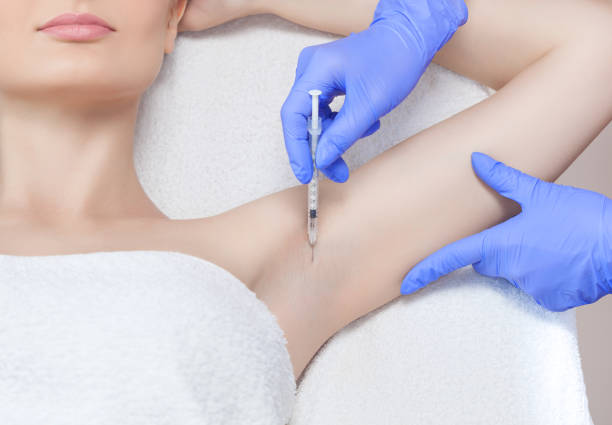
At Dr. Orhan Demirer’s dermatology practice in Alsancak, botulinum toxin is considered for selected underarm, palm or sole sweating only after the distribution, severity, daily impact and possible secondary causes are assessed. The aim is meaningful local reduction—not a promise of permanent or complete dryness.
- Primary focal and secondary sweating considered separately
- Underarm, hand and foot plans assessed independently
- Sweating field mapped before multiple small injections
- Area-specific comfort, function, risks and alternatives discussed
Not every episode of heavy sweating is primary hyperhidrosis
Primary focal hyperhidrosis typically affects defined areas—often both underarms, both palms or both soles—and can substantially interfere with clothing, work, device use, social contact or footwear. It often follows a long-standing pattern and commonly improves during sleep.
Secondary hyperhidrosis can be related to a medicine, hormonal or metabolic condition, infection, neurological or systemic illness, menopause or another cause. It may be more generalised, begin later or suddenly, occur at night, or appear with other symptoms. Treating one patch of skin without recognising the underlying cause can delay appropriate care.
Do not stop a prescribed medicine because you suspect it contributes to sweating. Bring an up-to-date medicine and supplement list so the possible relationship can be assessed safely.
Mention new, night-time or generalised sweating before booking an injection
Botulinum toxin may still be discussed later, but the priority is to understand the pattern. A clinical review can determine whether examination, medication review or additional medical testing is appropriate.
Urgent symptoms are assessed according to their cause. Severe chest pain, breathlessness, fainting or acute neurological symptoms should not wait for a routine cosmetic appointment.
Underarms, palms and soles are not treated as one standard package
The goal is local sweat reduction in the area that limits daily life. Skin thickness, pain sensitivity, muscle proximity, functional consequences and labelled product use differ by region.
Underarm sweating
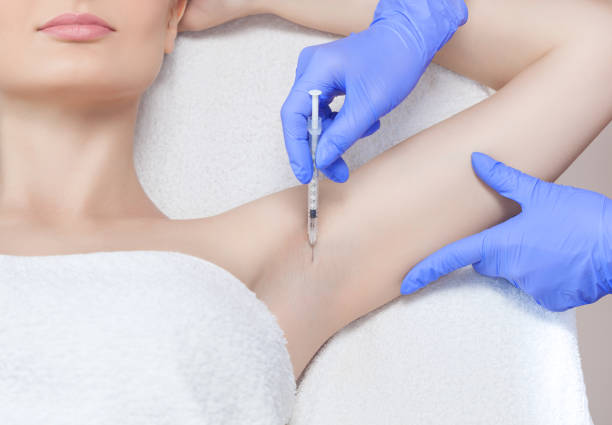
Visible wet patches, repeated clothing changes, irritation and social discomfort are common reasons for assessment. The sweating field may extend beyond the hair-bearing area and is mapped before injection.
Odour is not identical to sweat volume. Persistent odour, rash, folliculitis or skin breakdown may need separate care even if sweating improves.
Best-studied treatment area; product indication remains product- and jurisdiction-specific.
Palmar sweating
Wet palms can affect handshakes, handwriting, instruments, keyboards, touchscreens and fine manual work. Palmar skin is sensitive, so the comfort method deserves separate planning.
Temporary reduction in grip or fine hand strength can occur if nearby muscles are affected. Occupation, hobbies and hand dominance matter before treatment.
Hand function and pain control are part of the decision—not afterthoughts.
Plantar sweating
Sole sweating may affect socks, footwear, slipping and walking comfort. Thick, sensitive plantar skin can make multiple injections more uncomfortable than underarm treatment.
Foot odour, fungal infection, maceration, eczema or shoe-related irritation may continue unless these are diagnosed and treated separately.
Injection comfort, short-term walking discomfort and separate skin disease are considered.
How does botulinum toxin reduce sweating?
Botulinum toxin temporarily reduces acetylcholine signalling from local nerves to eccrine sweat glands in the injected field. The sweat glands are not surgically removed, and the body’s entire temperature-control system is not switched off.
As the nerve effect gradually recovers, sweating generally returns. The reduction may be incomplete or uneven, and duration varies with area, product, dose, field coverage and individual response.
The aim is meaningful control, not guaranteed complete dryness
What may improve
Clothing wetness, repeated wiping or changing, difficulty holding objects, social embarrassment and footwear discomfort may improve when the identified sweating field responds.
- Local sweat production in the injected area
- Daily practical burden
- Confidence in predictable situations
- Skin maceration caused mainly by moisture
What is not guaranteed
Complete dryness, permanent effect, identical response on both sides, elimination of body odour or treatment of an underlying medical cause cannot be promised.
- Sweat outside the injected field may continue
- Missed or resistant patches can remain
- Odour or infection may need separate treatment
- Effect gradually wears off
Botulinum toxin is one option—not an automatic first step for every area
The most appropriate approach depends on the location, severity, previous treatment, skin tolerance, medical history and acceptable burden. Options can be used in sequence or combination under medical guidance.
Clinical antiperspirants
Often an early option, especially for underarms. Correct timing and application matter; irritation or burning can limit use.
Iontophoresis
Often considered for palms and soles. It requires repeated sessions and maintenance; suitability depends on medical and device-specific precautions.
Oral medicines
Selected patients may discuss anticholinergic or other medical options. Dry mouth, blurred vision, urinary or heat-related effects can limit suitability.
Botulinum toxin
Can provide temporary local reduction for selected focal areas, but requires multiple injections and carries area-specific risks.
Surgery or permanent sweat-gland procedures have different indications and risk profiles and are not treated as interchangeable substitutes in an online comparison.
“Approved for sweating” does not mean every product is approved for every body area
For example, the current United States prescribing information for onabotulinumtoxinA includes severe primary axillary hyperhidrosis that is inadequately managed with topical agents. That same label states that safety and effectiveness for hyperhidrosis in other body areas have not been established. Palmar and plantar treatment may therefore be off-label depending on the selected product and jurisdiction.
Underarm
Has the strongest labelled evidence for certain products, but product name, local authorisation, patient selection and current instructions still matter.
Hands and feet
May be considered in selected clinical practice, with explicit discussion of off-label status, pain, function and the evidence limitations relevant to the chosen product.
See the current onabotulinumtoxinA prescribing information. The product information and regulatory status applicable in Türkiye take priority.
Who may be suitable—and when treatment may be postponed
Assessment may be relevant for
- Long-standing focal underarm, palm or sole sweating
- Symptoms that clearly disrupt clothing, work, hand use or footwear
- Insufficient benefit or intolerance from appropriately used antiperspirants
- Adults who accept multiple injections and a temporary effect
- Patients who understand area-specific discomfort and risks
- People able to attend or communicate for follow-up
Delay or additional review may be needed
- New generalised, night-time or one-sided sweating
- Active infection, open wound or inflammatory disease in the field
- Known hypersensitivity to the selected product
- Neuromuscular junction disorder or important weakness
- Clinically significant swallowing or breathing difficulty
- Pregnancy or breastfeeding for an elective treatment
Share all medicines, supplements, allergies, previous toxin dates and products, muscle or nerve disorders, breathing or swallowing problems and planned procedures. Do not stop blood thinners or any prescribed medicine without the prescriber’s advice.
What is assessed before treatment?
Pattern and onset
Age at onset, focal or generalised distribution, symmetry, frequency and whether sweating continues during sleep are documented.
Daily impact
Clothing changes, work, writing, devices, tools, footwear, exercise and social impact help define treatment value.
Possible causes
Medical history, systemic symptoms, medicines and recent changes are reviewed to decide whether further evaluation is needed.
Skin condition
Rash, irritation, maceration, folliculitis, fungal infection, wounds and previous deodorant reactions are checked.
Previous treatments
Antiperspirants, iontophoresis, medicines, toxin product and duration, side effects and untreated patches inform the next plan.
Function and comfort
Hand strength needs, walking, pain sensitivity and the feasibility of area-specific anaesthesia or cooling are discussed.
How is hyperhidrosis botulinum toxin performed?
A named body area is not a complete treatment plan. The active sweating field, sensitivity and nearby muscle function determine how the procedure is approached.
History and examination
The sweating pattern, possible secondary causes, contraindications and previous treatment response are reviewed.
Field mapping
The area is examined and marked. A starch–iodine test may be used when the active border is not sufficiently clear.
Comfort plan
Topical anaesthetic, cooling, vibration or another method may be considered according to the region and patient.
Multiple small injections
Small intradermal deposits are distributed across the planned field. Point count and product-specific dose are individual.
Immediate check
Injection marks, bleeding, comfort and area-specific instructions are reviewed before leaving the practice.
Response review
After the effect develops, overall reduction, gaps, symmetry, function and adverse effects can be assessed.
A larger or irregular sweating field can require a different grid from a compact bilateral underarm area.
Doses belong to the selected product; units from one botulinum toxin preparation cannot be converted directly to another.
Two underarms, two palms and two soles differ substantially in field size, sensitivity, function and follow-up need.
When does the effect begin and how long may it last?
Treatment does not reach its final effect on the same day. Duration varies between people and between body areas.
The field is mapped and injected. Pinpoint marks, tenderness, redness or bruising may occur.
Many patients begin to notice reduction gradually. Continued sweating during the first days is not proof of failure.
Overall reduction, skipped patches, symmetry and any functional change are more meaningfully assessed.
The effect gradually fades. Underarm benefit is often around six months, but shorter or longer responses occur; hands and feet vary.
Repeat treatment is decided after sweat and daily-life impact return—not automatically on the shortest advertised calendar interval.
Follow the instructions for the treated area
Most patients return to ordinary low-impact activities, but underarm, palm and sole aftercare is not identical. The treating physician’s written advice takes priority over generic rules online.
Do not repeatedly rub, massage or press the injection grid. Do not test the result every hour; sweat reduction takes days. Report increasing pain, heat, spreading redness, discharge, marked weakness or another unexpected change.
- Keep the injection sites clean as advised.
- Avoid sustained rubbing or pressure over the treated grid.
- Follow area-specific timing for strenuous exercise, heat and deodorant.
- Expect possible pinpoint tenderness, redness, swelling or bruising.
- Use hands and feet normally unless individual advice says otherwise.
- Do not stop prescribed medication because bruising occurs.
Possible side effects and area-specific risks
Botulinum toxin treatment is usually tolerated in appropriately selected patients, but “non-surgical” does not mean risk-free. Adverse effects can relate to the needles, the selected product, local diffusion or systemic toxin effect.
Injection-site effects
Pain, tenderness, redness, swelling, bruising, small bleeding points, itching, headache or infection can occur. Palm and sole injections may be substantially more uncomfortable than underarm treatment.
Response-related effects
Reduction may be incomplete, patchy, asymmetric or shorter than expected. Sweating elsewhere may be noticed; this is possible but neither inevitable nor predictable for every patient.
Hand and foot function
Palmar treatment can temporarily reduce grip or fine hand strength. Plantar injections can cause tenderness or short-term walking discomfort. These risks matter for work, sport and travel plans.
Allergy and toxin spread
Hypersensitivity and unwanted weakness are possible. Risk depends on product, dose, medical history, injection field and concurrent medicines or toxin exposure.
Seek urgent medical help for difficulty swallowing, speaking or breathing; generalised weakness; double vision; drooping eyelids; widespread allergic swelling; or rapidly worsening symptoms. Do not wait for a routine review or message reply.
Safety, product-specific units, secondary-cause evaluation and the labelled axillary indication were cross-checked against the current onabotulinumtoxinA prescribing information. The American Academy of Dermatology treatment overview and causes overview provide additional patient guidance. Local product information and the personal medical plan take priority.
Which option may be considered for which sweating pattern?
| Option | Commonly considered for | Practical advantage | Important limitation |
|---|---|---|---|
| Clinical antiperspirant | Often an early step for focal underarm, hand or foot sweating | Non-invasive and used at home | Correct application matters; irritation and insufficient control can occur |
| Iontophoresis | Especially palms and soles in suitable patients | Needle-free home maintenance may be possible | Repeated sessions, device access and precautions are required |
| Oral medication | Selected multi-area or difficult patterns | Can act beyond a single injected field | Systemic side effects and heat regulation require individual assessment |
| Botulinum toxin | Selected focal underarm, palm or sole sweating | Local temporary reduction without daily treatment | Multiple injections, temporary effect, cost and region-specific risks |
| Cause-directed treatment | Secondary hyperhidrosis | Addresses the medicine or medical driver when possible | Requires correct diagnosis; a local injection alone may be inappropriate |
Hyperhidrosis Botox prices in Izmir
Pricing depends on the treated region, whether one or both sides are included, field size, selected product, product-specific dose, number of injection points, comfort method and follow-up plan. Two underarms are not equivalent to two palms or two soles.
A low package price cannot show whether the product is authorised, the field is fully covered or review is included. The exact scope and fee are discussed after medical assessment.
Tell the practice where sweating occurs, how long it has been present, whether it happens during sleep and what you have already tried.

Hyperhidrosis treatment planning with Dr. Orhan Demirer
Dr. Orhan Demirer is a specialist dermatologist practising in Alsancak, Izmir. He evaluates whether sweating is focal or potentially secondary, checks the skin and functional needs, reviews previous treatment and then discusses the most proportionate option.
If botulinum toxin is selected, the region, active sweating field, comfort plan, product, limitations and review are documented. If the pattern suggests another medical cause or a different treatment would be more appropriate, injection is not treated as the default answer.
- Specialist dermatology assessment
- Cause and distribution considered first
- Area-specific risk and comfort planning
- English communication available
Planning hyperhidrosis treatment in Izmir from abroad
International visitors can share the affected area and previous treatment before travelling, but photographs cannot establish whether sweating is primary, measure functional risk or determine the final injection map.
Share the area, duration, night-sweat pattern, medicines, medical conditions, previous product/date and upcoming hand-intensive work or travel.
The distribution, skin, daily impact, possible secondary causes, field size and area-specific comfort are assessed.
Because the effect develops over 1–2 weeks, agree how response, skipped patches, weakness or another concern will be reviewed after departure.
Frequently asked questions about Hyperhidrosis Botox in Izmir
What is hyperhidrosis?
Hyperhidrosis is sweating that is excessive for the situation and causes practical, social or emotional burden. It may be primary and focal or secondary to a medicine or medical condition.
Which areas can be assessed for hyperhidrosis botulinum toxin?
The underarms are most commonly assessed. Palms and soles may also be considered in selected adults, but sensitivity, function, evidence and product-label status differ by area.
Does treatment stop all body sweating?
No. It temporarily reduces nerve signalling to sweat glands in the injected field. It does not switch off the body’s entire sweating or temperature-control system.
Will I become completely dry?
Complete dryness cannot be guaranteed. The realistic aim is a meaningful reduction in the local sweating that disrupts clothing, work, hand use, footwear or social comfort.
How soon does hyperhidrosis Botox work?
Many patients notice initial reduction within about 7–10 days. The result is usually assessed more meaningfully around 1–2 weeks rather than on the treatment day.
How long does underarm Botox for sweating last?
Underarm benefit is often discussed around six months, but a shorter or longer response is possible. Product, dose, field coverage and individual biology affect duration.
Do hand and foot results last six months?
They may, but duration is less predictable and should not be assumed from underarm results. Palms and soles differ in anatomy, function, injection tolerance and individual response.
Are the injections painful?
There are multiple small injections. Underarm discomfort is often manageable, while palms and soles can be considerably more sensitive. Comfort options are planned by region.
Can palm treatment weaken my grip?
Yes. Temporary reduction in grip or fine hand strength can occur if nearby muscles are affected. Occupation, instruments, sport and dominant-hand demands should be discussed first.
Can sole treatment affect walking?
Injection tenderness can produce short-term walking discomfort. This risk and the timing of work, sport or travel should be discussed before plantar treatment.
Can sweating increase somewhere else?
Some patients notice increased sweating outside the treated field, but it is neither inevitable nor predictable. Local toxin treatment does not aim to redirect or stop all body sweating.
Is treatment approved for the palms and soles?
Approval is product- and jurisdiction-specific. For example, the US onabotulinumtoxinA label covers selected severe primary underarm sweating and states that safety and effectiveness in other body areas have not been established. Hand and foot use may therefore be off-label.
How many injections are needed?
There is no universal point count. The number depends on field size, distribution, selected product and area. The active sweating border is mapped so small injections can cover it evenly.
Can Botox treat night sweats?
New or significant night sweating is not automatically treated with local injections. Medicines, hormonal, infectious, neurological and other systemic causes may need evaluation first.
Will treatment remove underarm or foot odour?
Reducing moisture may help some odour, but odour is not identical to sweat volume. Bacterial imbalance, fungal infection, skin inflammation, footwear or other causes can need separate treatment.
Can I have treatment during pregnancy or breastfeeding?
Dr. Orhan Demirer generally postpones elective botulinum toxin treatment during pregnancy and breastfeeding because safety information is limited.
When can treatment be repeated?
Repeat treatment is considered after benefit has worn off and sweating again causes meaningful burden. It should follow reassessment rather than the shortest fixed calendar interval.
How much does Hyperhidrosis Botox cost in Izmir?
The fee depends on area, field size, both-sided treatment, product, product-specific dose, point count, comfort method and follow-up. A personal scope is discussed after assessment.
First identify the sweating pattern; then choose the area-specific option
A personal plan begins with the cause, region and daily impact—not with a fixed injection package.