Focused ultrasound should follow anatomy—not a fixed shot count
At Dr. Orhan Demirer’s dermatology practice in Alsancak, HIFU is planned according to the dominant cause of facial or neck laxity, tissue thickness, target depth and the fat compartments that should be preserved. The aim is measured, gradual tightening in a suitable patient—not a device-led promise of a surgical facelift.
- Dermatologist-led face and neck assessment
- Layer-specific cartridge and energy planning
- Conservative protection of facial fat compartments
- Alternatives discussed when volume loss, local fat or surgery is the real need

What is HIFU—and what does the energy actually do?
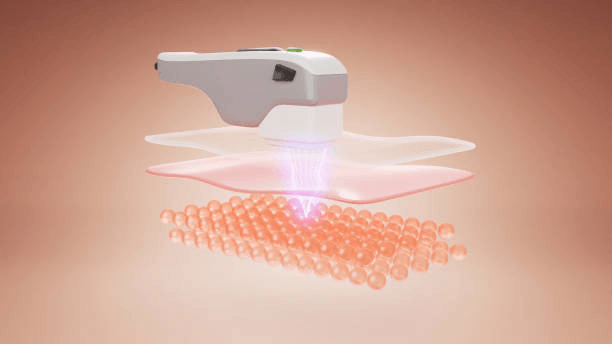
A HIFU handpiece concentrates ultrasound energy at small focal points beneath the skin. At the selected depth, controlled thermal coagulation zones are produced while the surface is largely spared. This can cause short-term collagen contraction and a later remodelling response.
The concept is straightforward; safe treatment is not. Nominal cartridge depth does not guarantee that the same anatomical structure lies at that depth in every patient or every facial zone. Tissue thickness, coupling, pressure, energy, line spacing, passes and nearby bone, nerves and vessels all influence what is reached.
HIFU is not a surface laser, filler or fat-removal operation. It may create moderate tightening in a suitable patient, but it does not surgically reposition retaining ligaments, remove advanced skin excess or restore lost skeletal support.
Which anatomical layer is the intended target?
The cartridge name is only a starting point. The practical question is why energy is being placed at that depth in that region—and which structures must be avoided or preserved.
Skin quality and superficial tightening
More superficial focal depths may be considered for dermal remodelling in selected areas. Thin or sensitive skin requires conservative energy and density.
Priority: thickness and sensitivity
Connective-tissue support
Selected fascial and connective-tissue laxity may contribute to contour change, but this layer varies across the face.
Priority: tissue mobility and support
Deeper tightening target
Deeper cartridges may approach fascial or platysmal planes in the lower face and neck. Regional nerve and vessel anatomy makes mapping essential.
Priority: safe anatomical boundaries
Volume that may need protection
Facial fat is not simply excess. Temple, periorbital and mid-face fat supports a youthful contour and may already be depleted with age.
Priority: avoid unwanted atrophy
Limits of non-surgical lifting
Ligaments and facial soft tissues change with age. HIFU does not surgically release, shorten or reposition the complete retaining system.
Priority: realistic scale of change
Projection and proportion
A retruded chin or reduced mid-face support can resemble laxity. Tightening alone may not correct the profile and can expose volume deficiency.
Priority: tightening or support?
A “4.5 mm cartridge” does not automatically mean the SMAS is treated accurately everywhere. Actual anatomy and tissue compression vary by region and individual.
Which areas may be assessed for HIFU?
Suitability is decided zone by zone. A cartridge that is reasonable along part of the jawline may be inappropriate over a thin cheek, temple or high-risk anatomical line.
Early jowls
Selected mild-to-moderate tissue laxity where the main concern is descent rather than severe volume loss or skin excess.
Jawline definition
For selected early blurring caused by laxity; the plan changes if local fat or a retruded chin is dominant.
Under-chin laxity
When looseness contributes more than a large fat compartment, prominent glands or insufficient chin projection.
Mild neck laxity
Selected superficial and platysmal laxity, with attention to the thyroid region, vessels, nerves and neck anatomy.
Why the upper and mid-face require restraint
Temples, the eye area and the central mid-face often lose volume with age. Unnecessary deep energy, excessive density or repeated treatment in these zones can worsen hollowing, fatigue the appearance or create contour irregularity.
The goal is not to make every face thinner. If volume loss is the dominant issue, structural filler assessment or another support strategy may be more coherent than further tightening.
The practice does not routinely apply HIFU through volume-depleted temples or cheeks merely to complete a “full-face package.” The eye area requires device-specific cartridges, strict boundaries and careful indication.
HIFU is planned as an anatomy treatment—not a shot package
Classify the problem first
Skin laxity, local fat, volume loss, muscle activity and skeletal support are separated before choosing a device.
Choose depth by region
The forehead, cheek, jawline, submental area and neck should not receive identical cartridges, energy or line density.
Protect facial fat
Particularly in the upper and mid-face, maintaining structural fat can be more important than maximising the number of lines.
Recommend another method when appropriate
Volume loss may need filler, local submental fat may favour Endolift-style laser contouring, and advanced laxity may warrant a surgical opinion.
Who may be suitable—and when HIFU may be insufficient
Assessment may be relevant for
- Mild-to-moderate face or neck laxity
- Early jawline blurring or early jowl appearance
- Under-chin laxity without a dominant large fat compartment
- Relatively preserved facial volume and suitable tissue quality
- Adults who prefer a non-invasive, gradual approach
- Patients with realistic expectations of moderate—not surgical—change
Another method or postponement may be safer
- Advanced skin excess or heavy tissue descent
- Marked facial volume loss or a hollow appearance
- Substantial submental fat, prominent glands or major chin retrusion
- Active infection, open wound or uncontrolled skin inflammation in the area
- Medical or device-specific contraindications identified at consultation
- Expectation of immediate, dramatic or guaranteed lifting after one session
Elective treatment is generally deferred during pregnancy and breastfeeding. Tell the physician about implanted devices, metal or permanent material in the area, fillers, threads, surgery, dental work, medicines, neurologic symptoms and previous HIFU or energy-based procedures. Device-specific labelling takes priority.
What is examined before a HIFU plan is made?
Photographs help document the starting point, but they cannot show tissue thickness, palpation findings or the full relationship between laxity, fat, bone and muscle.
Skin thickness
Thin and thick tissue do not justify identical cartridges, pressure, energy or line density.
Fat compartments
The examination identifies which volume is structural, which may be excessive and which areas should not be targeted.
Degree of laxity
Mild, moderate and advanced descent have different ceilings for non-surgical improvement.
Chin and skeletal support
A profile deficit may persist despite tightening and can become more noticeable after volume reduction.
Muscle and neck anatomy
Platysma bands, submandibular glands, thyroid region, vessels and nerve pathways affect safe boundaries.
Previous procedures
Fillers, threads, HIFU, RF, laser, Endolift and surgery can alter tissue planes and sequencing.
How is HIFU performed?
The procedure is non-invasive, but it still requires deliberate marking, coupling and region-specific energy delivery.
Standardised photographs
Front, oblique, profile and neck views document baseline anatomy and help later comparison.
Anatomical mapping
Treatment zones, bony edges and structures or areas to avoid are marked before energy delivery.
Cartridge selection
Nominal focal depth is chosen for the intended tissue layer and adjusted between regions.
Coupling and contact
Appropriate ultrasound gel and complete handpiece contact are maintained; poor coupling can affect delivery and surface safety.
Controlled treatment lines
Energy, spacing, passes and density are adapted to anatomy and tolerance rather than copied as a fixed full-face pattern.
Aftercare and review
Expected tenderness, warning signs and an appropriate result-assessment interval are explained.
What may happen after HIFU?
Many patients can return to routine activities quickly, but “no downtime” does not mean no discomfort, swelling or risk.
Temporary redness, warmth, tenderness or a tight sensation may occur.
Touch sensitivity, mild oedema, tingling, bruising or discomfort near bone may be noticeable.
An early firm feeling may occur, but it should not be interpreted as the complete outcome.
Collagen remodelling may make a measured contour change easier to see.
The result can be assessed more realistically before routine repetition is considered.
Ageing continues, and duration varies with baseline laxity, tissue quality, weight change, device, parameters and individual biology. A fixed promise of “12–24 months” is not medically reliable for every patient.
Why can HIFU appear ineffective?
An underwhelming result is not always evidence that the machine was weak. The target, diagnosis and expectation may have been mismatched.
Expecting surgical-scale correction from a non-invasive procedure.
Treating a hollow or unsupported face as though it only needs tightening.
Using tightening energy where fat volume or another structure drives the contour.
A cartridge, line or energy plan that does not correspond to the intended tissue.
Insufficient dose may not produce a response; excessive treatment can create injury or unwanted fat loss.
Judging collagen remodelling within days rather than allowing an appropriate interval.
Possible side effects, complications and warning signs
Risk depends on the exact device, transducer, delivered energy, coupling, treatment map, operator technique, anatomy and previous procedures. Published studies generally support short-term safety in appropriately selected patients, while also describing uncommon but important adverse outcomes.
Expected or relatively common
Pain during treatment, tenderness, erythema, mild swelling, bruising, tingling, temporary numbness and sensitivity to touch can occur.
Less common but clinically important
Burns, blistering, pigment change, prolonged pain or numbness, nodules, contour irregularity, unintended fat loss or hollowing, scarring after skin injury and unsatisfactory asymmetry are possible.
Nerve and muscle effects
Temporary nerve irritation, altered sensation, weakness, paresis or unexpected change in facial movement has been reported. Accurate anatomical boundaries reduce but do not eliminate risk.
Need for assessment
Do not wait for a routine review if pain is worsening, swelling is marked or one-sided, the skin blisters or changes colour, or new movement or sensory loss appears.
Prompt medical assessment is required for severe or increasing pain, blistering or grey/dark skin, rapidly enlarging swelling, persistent marked numbness, new facial asymmetry or muscle weakness, visual symptoms, difficulty swallowing or difficulty breathing. Breathing or swallowing difficulty requires urgent emergency care.
The evidence summary was cross-checked against a systematic review and meta-analysis of facial and neck HIFU reporting moderate average improvement and limited long-term data, and a systematic review of reported adverse events. These findings describe groups and devices, not an individual guarantee.
“FDA-cleared HIFU” is not a category-wide claim
Regulatory clearance belongs to a specific manufacturer, model and labelled indication. It does not automatically extend to every device marketed as HIFU, every cartridge, every body area or every clinic outside the United States.
Ask for the exact platform
The device name, transducers, nominal focal depths, local regulatory status and intended treatment zone should be identifiable before consent.
Do not borrow another brand’s evidence
For example, the FDA database records device-specific clearance for the Ulthera System and defined indications. That clearance is not proof for an unrelated generic system.
See the official FDA 510(k) record for the Ulthera System (K134032). This page does not claim that every HIFU system has that clearance.
HIFU, Endolift, filler, botulinum toxin, RF microneedling or surgery?
The methods below act at different levels. A patient may need one, a staged combination—or no procedure.
| Method | Main target | May be more relevant when | Important limitation |
|---|---|---|---|
| HIFU | Selected deep tissue tightening | Mild-to-moderate laxity, early jowls or selected neck looseness | Does not remove substantial fat, refill lost volume or reproduce surgical lifting |
| Endolift-style laser | Selected local fat plus subdermal contraction | Submental, jawline, lower-face or lateral-neck fullness with a treatable fat component | Minimally invasive with visible swelling; not a surgical substitute |
| Filler / biostimulator | Volume and structural support | Chin retrusion, mid-face support loss or volume depletion dominates | Adds support or volume; it does not remove skin or submental fat |
| Botulinum toxin | Muscle activity | Selected platysma bands, mimetic lines or a Nefertiti-style muscle plan | Does not physically tighten lax skin or remove fat |
| RF microneedling | Skin texture and dermal remodelling | Pores, selected acne scars, fine lines or superficial tissue quality is the main concern | Not the main method for advanced jowls or heavy neck laxity |
| Fractional CO₂ | Resurfacing and texture | Acne scars, surface wrinkles or photodamage require controlled resurfacing | Does not create a surgical fascial lift |
| Surgical face/neck lift | Advanced structural repositioning and skin excess | Marked descent, significant skin excess or surgical-scale change is desired | More invasive with surgical recovery and risks, but may be the proportionate option |
When may HIFU be combined with another method?
Combination should mean distinct targets and an intentional sequence—not stacking devices to make a package appear stronger.
HIFU + filler
May be staged when laxity and structural support loss coexist. Depth, product location and timing influence the sequence.
HIFU + botulinum toxin
Fascial laxity and muscle activity are different targets. Treatment zones and timing are planned separately.
HIFU + RF microneedling
Deep tightening and superficial texture are different objectives; cumulative inflammation and recovery should be considered.
HIFU + fractional laser
Resurfacing may address texture or scars, but it should not be combined automatically with a deep energy procedure.
HIFU + Endolift
The fat and laxity components must be separated. Treating the same target twice without a rationale can increase risk without improving value.
HIFU + skin care
Barrier support, hydration and photoprotection can improve surface quality, but they do not create the same deep tightening effect.
HIFU prices in Izmir
Pricing depends on the treatment zones, number and type of cartridges, anatomical mapping, device system, energy and line plan, procedure time and follow-up. A small submental zone and a combined lower-face and neck plan are not the same treatment.
Shot count alone is not a meaningful quality measure. A very high number can represent a larger area, a different cartridge, low energy, overlapping treatment—or unnecessary exposure. Scope and fee are discussed after assessment.
For scheduling guidance, share your main concern and any previous HIFU, filler, thread, Endolift, laser or surgical procedure. Photographs do not guarantee same-day treatment.

HIFU planning with Dr. Orhan Demirer
Dr. Orhan Demirer is a specialist dermatologist practising in Alsancak, Izmir. The consultation evaluates skin thickness, facial fat, laxity, chin and skeletal support, platysma, neck anatomy, asymmetry, previous procedures and the scale of change that can reasonably be achieved without surgery.
If HIFU is not the proportionate option, structural filler, botulinum toxin, RF microneedling, Endolift-style laser contouring, observation or a surgical opinion may be discussed. The objective is not to perform HIFU on every person who requests lifting; it is to define a defensible tissue target.
- Specialist in dermatology
- Facial anatomy and skin assessment
- Multiple energy-based and injectable options
- English communication available
Planning HIFU in Izmir from abroad
Visitors should allow time for in-person examination and access to follow-up. A photograph cannot confirm tissue depth, fat distribution, device suitability or whether treatment will be performed on the same day.
Share preferred dates, the area of laxity, medical history, medicines and previous facial procedures.
Although recovery is often socially short, tenderness, swelling, bruising or temporary asymmetry may be visible.
Know when results will be reviewed and how to obtain assessment if pain, weakness or a skin change develops.
Frequently asked questions about HIFU in Izmir
What is HIFU?
HIFU is a non-invasive method that creates focused ultrasound energy at selected depths to stimulate controlled thermal coagulation, collagen remodelling and measured tissue tightening.
Does HIFU really lift the face?
It may produce moderate, gradual tightening in mild-to-moderate laxity. It does not surgically reposition all facial tissues or remove advanced excess skin.
Is HIFU painless?
No universal promise can be made. Warmth, sharp tingling, electrical sensations or tenderness near bone may occur. Published studies report meaningful variation in pain.
Does HIFU melt facial fat?
Some depths and energy patterns can affect fat, but facial treatment should not automatically aim to destroy volume. Structural fat in the temples, cheeks and eye region often needs protection.
Can HIFU make the face look hollow?
Unwanted fat loss is possible when depth, energy, density, passes or repeat treatment are inappropriate for a thin or volume-depleted face. Anatomical mapping and conservative selection reduce but do not remove the risk.
How many HIFU shots are needed?
There is no universal number. Area, cartridge, device, energy, line spacing, tissue thickness and the clinical target must be considered together. More shots are not automatically better.
Does the HIFU device brand matter?
Yes, device design, focal geometry, cartridge consistency, energy calibration, imaging capability, labelling and quality controls differ. However, a brand name cannot compensate for poor patient selection or anatomy planning.
Is every HIFU device FDA-cleared?
No. Clearance belongs to a specific model and indication in the United States. A clearance for one manufacturer cannot be transferred to an unrelated device or every area marketed as HIFU.
When does the result appear?
An early firm sensation may occur, but a more realistic change may become visible over approximately 1–3 months. Assessment can extend to 3–6 months depending on tissue response.
How many sessions are required?
Some patients may have a single-session plan, but routine short-interval repetition is not appropriate for everyone. The first response should heal and be assessed before additional energy is proposed.
How long does the HIFU result last?
There is no guaranteed duration. Age, baseline laxity, weight change, tissue quality, device, parameters and ongoing ageing influence how long the visible change remains.
HIFU or Endolift—which is better?
HIFU is non-invasive and mainly considered for selected laxity. Endolift-style treatment introduces an optical fibre beneath the skin and may address selected local fat plus contraction, with more visible recovery. Anatomy determines the choice.
HIFU or filler?
If laxity dominates, HIFU may be relevant. If chin projection, skeletal support or volume loss dominates, filler or another structural method may make more sense. Some patients have both issues.
HIFU or RF microneedling?
HIFU targets selected deeper tissue planes. RF microneedling is generally used for dermal remodelling, texture, pores and selected scars. They should not be treated as interchangeable lifting devices.
Can HIFU be used around the eyes or temples?
These are thin, volume-sensitive and anatomically complex areas. Treatment requires a device-specific suitable cartridge and strict safety boundaries. The practice does not routinely treat volume-depleted temples simply as part of a full-face package.
Can HIFU be applied beneath the chin or on the neck?
It may be considered for selected laxity. A large fat compartment, prominent glands, chin retrusion, thyroid region and local nerve or vessel anatomy can make another plan more appropriate.
Can HIFU cause nerve injury?
Rare nerve irritation, altered sensation or temporary weakness has been reported. A new change in facial movement, marked numbness or severe pain requires prompt medical assessment.
Can HIFU be performed during pregnancy?
Elective aesthetic HIFU is generally deferred during pregnancy and breastfeeding because there is no medical urgency and safety evidence is limited.
How much does HIFU cost in Izmir?
The fee depends on the treatment zones, cartridges, anatomical plan, device system, procedure time and follow-up. An individual scope and fee are discussed after assessment rather than priced by shot count alone.
First decide whether the face needs tightening, support, fat reduction or surgery
A personal HIFU plan begins with anatomy and a defined tissue target—not a fixed full-face shot package.